Posted on

More Than a Miracle – the lost classic – now beautifully restored, on VOD!

More Than a Miracle – Now on VOD!

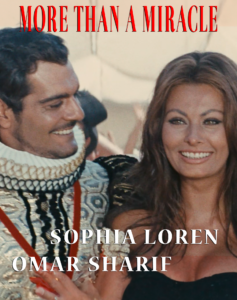
Enter a world of romance, adventure, and pure magic with epoch-making super-stars Sophia Loren and Omar Sharif in the captivating “More Than a Miracle.”
This enchanting fairy tale – which has just been revived after a painstaking 4K restoration -whisks us away to 17th-century Naples, where a spirited young peasant (Sophia Loren) embarks on an extraordinary journey filled with whimsy, humour, and romance.
Expect flying monks, mischievous witches, and even a royal dishwashing contest! Amidst this vibrant chaos, she crosses paths with a headstrong Spanish prince (Omar Sharif), whose heart and mind are as untamed as the fantastical events unfolding around them. As their lives intertwine, they learn that the most potent magic of all is love.
Heart-throb Omar Sharif gained global stardom from one of the most celebrated and award-winning films of all time “Lawrence of Arabia” and the epoch-making romance “Doctor Zhivago”.
Like the earlier Zhivago, “More Than a Miracle” with its a dazzling large-vista spectacle was also produced by the legendary Carlo Ponti – who was married to Loren! The film unites the two all-time cinema icons, with the ®Oscar-winning Loren continuing her string of unforgettable performances like “Two Women” and “Marriage Italian Style (to name but two of Loren’s other Ponti-backed multi-awarded classics).
Directed by Francesco Rosi, boasting breathtaking cinematography and a truly mesmerizing score, “More Than a Miracle” is a sumptuous fairy tale adventure that defies expectations.

Stream More Than a Miracle now on Amazon

Posted on

Liliana Cavani at 90

Liliana Cavani & Charlotte Rampling on set
Raising a glass on set, to Liliana Cavani! Photograph by Mario Tursi, courtesy of Liliana Cavani.


Today CultFilms honours a cinematic visionary, the Carpigian director Liliana Cavani who celebrates her 90th birthday on this day.

Transgressive, bold and full of unbridled conviction, Cavani made her mark on the cinematic landscape evolving from astute documentarian to fearless filmmaker in an illustrious career that spans over seven decades, Cavani, a female director — a rarity in her period of filmmaking — has continuously demonstrated a sensitivity and profound understanding towards her cinematic subjects which shines throughout her varied filmography. Her cinematic oeuvre a wealth of transgressive, powerful works rooted in the complexities of the human condition with an astute awareness of how our collective past informs upon our present.

After graduating from Bologna University in Linguistics and Philology, Cavani abandoned her initial plans to become an archaeologist, instead pursuing a love of cinema ingrained in her at an impressionable age. This led to a move to Rome to study documentary filmmaking at the prestigious Centro Sperimentale di Cinematografia — an institution that counts Michelangelo Antonioni and Marco Bellocchio as past graduates. Upon graduation, Liliana Cavani began shooting documentaries for Italian state broadcaster Rai before transitioning to fiction. Cavani’s work as a documentarian would be indicative of her great interest in the intersection between the political and the historical, a theme present in many of her documentaries of the 1960s. It was during this period that Cavani would shoot documentaries on topics such as the history of the Third Reich and the Stalin years and, most notably, the contribution and experiences of women who participated in the Italian Resistance in La donna nella Resistenza.

Cavani’s work as a documentarian was followed by a biographical film for Rai on Francesco d’Assisi in 1966. The film, starring Lou Castel as d’Assisi, attracted controversy in its depiction and apparent criticism of Catholicism, dubbed as blasphemous amongst swathes of the Italian population. The controversy would come to signify a common strand in Cavani’s career in which her taboo-shattering works would attract the ire of religious conservatives. Never the less, Cavani would remain loyal to her convictions continuing to explore contentious subject matter throughout the course of her career, not as a means of courting controversy but as a pursuit of her intellectual interests and civic duty.

Cavani’s first cinematic foray came somewhat accidentally in 1968 with Galileo; a biographical picture detailing the life of the celebrated Italian astronomer and scientist, Galileo Galilei. The film, originally devised as a production for television, was banned by the Italian censor due to its anticlerical subject matter subsequently becoming a cinematic release upon securing a distributor. Cavani’s depiction of Galileo as a historical figure placed particular emphasis on the conflict between scientific advancement and experimentation against the oppressive orthodoxy of religion. However, the overarching focus of the picture was arguably the societal — as well as personal — ramifications of the suppression of free thought by the church as an all encompassing, powerful institution, a theme that carried great resonance in the late sixties at the time of the film’s production. Cavani, a director intently interested in the humanity of her subjects, brought pathos to her depiction of Galileo as a misunderstood and isolated individual propelled by great conviction and intelligence. Galileo, a heretic and a challenger to established thought would somewhat mimic Cavani’s own fearlessness in her approach to filmmaking as a tool of civic importance.

Galileo’s overarching political convictions would continue throughout Cavani’s filmography and into her next cinematic endeavour, I cannibali in 1969; a modern reinterpretation of the Antigone of Sophocles which would capture the tumultuous socio-political landscape of the era in its stark and unwavering allegorical political odyssey. The film featured central performances from a pre-Bond Britt Ekland and poster child for 1960s counterculture, Pierre Clementi capitalising on both actors enigmatic and hippie like qualities capturing the cultural zeitgeist of the period. Experimental in nature and imbued with powerfully symbolic imagery, Cavani’s surrealistic cinematic dystopia would reveal the director’s poetic visual language exemplified in the bleak images of corpse laden grey Milanese streets. The film would become, in Cavani’s words, “a tragic prophecy” eerily predicting the Piazza Fontana bombing in Milan in the December of 1969.

Cavani’s next work was a contemporaneous picture, the Lucia Bosè helmed L’ospite in 1971. The film was a continuation of the Carpigian director’s interest in psychological themes as well as ones of civic import. L’ospite concerns the release of a woman, played by Lucia Bosè, afflicted with mental illness and her struggle to re-enter society after a prolonged period confined within a psychiatric hospital. The relationship between Bosè’s Anna and writer, Piero (Glauco Mauri) is utilised as a means of exploring the complexities of female psychiatric illness and the challenges that befall those exiting psychiatric institutions as they try to adapt back into society. Cavani’s film was pertinent in a society where psychiatric institutions and treatment of mental illness was increasingly under the microscope. The conversation surrounding mental health care in Italy, highlighted by films such as Cavani’s, reached a crescendo in 1978 with the passing of the Basaglia Law in which mental health care was restructured in Italy with the closure of all psychiatric hospitals.

Despite L’ospite’s limited budget, the film would prove to be an important work and was submitted out of competition to the Venice Film Festival. The involvement of Bosè, a greatly respected figure in Italian cinema, lent Cavani’s film a certain cinematic pedigree. Throughout Cavani’s career she would align herself with titans of cinema such as Marcello Mastroianni, Dirk Bogarde and Michel Piccoli; a testament to her artistry and reputation as a filmmaker. Whilst, her cinematic output was perhaps not as plentiful as some of her contemporaries, the onus for Cavani was on quality projects that interested her, a directorial approach that would not falter throughout her career.

The 1970s continued to be a fruitful and diverse period for Cavani as she embarked on her next project, the ambitious undertaking of a cinematic adaptation of the philosophical teachings of Tibetan Yogi, Milarepa. With an unconventional narrative structure, the likes of which had previously been experimented with in I cannibali, Cavani tells the story of Milarepa concurrently with that of a young boy in the modern age. Such parallels reveal a meditative tale on the quandaries of modern life, the significance and similarities of the past and our individual and collective destinies and the role of spiritualism in an increasingly divisive and technologically advanced age.

Milarepa would be followed by Cavani’s most audacious and internationally renowned work, Il portiere di notte (The Night Porter); a haunting, psychological drama about the rekindling of a sadomasochistic relationship between a concentration camp survivor and her former persecutor after they are reacquainted by happenstance in postwar Vienna. Cavani explores the lasting psychological effects of the Nazi regime with sensitivity whilst detailing the complex and disturbing implications of her subject underlined by provocatively unflinching imagery. The transgressive power of ‘The Night Porter’ was celebrated by many whilst condemned in equal measure, criticised for its controversial subject matter. Cavani, a fearless auteur powered by personal conviction, welcomed the wider debate that her film generated — a debate that continues fifty years after its initial release. With powerful leading performances from Charlotte Rampling and Dirk Bogarde set against the sumptuous yet simultaneously bleak environments that Cavani was so adept at cultivating, ‘The Night Porter’ remains one of her greatest and most powerful works.

Cavani courted controversy once again in 1977 with Al di là del bene e del male (Beyond Good and Evil); a loosely biographical account of German philosopher, Friedrich Nietzsche and his tempestuous relationships with German author, Paul Rée and Russian feminist writer and psychoanalyst, Lou Andreas-Salomé. Al di là del bene e del male’s sumptuous 19th century setting and sceneographies evoke the feel of the work of Visconti whilst the film’s thematic tenants relating to morality, sexual transgression and personal liberation feel firmly Cavanian. Much of the film’s controversy derived from the scandalous nature of its subject matter and depiction of homoerotic sexual acts. Yet despite the furore that engulfed the film upon release, Al di là del bene e del male also found its ardent supporters becoming one of Cavani’s most celebrated and transgressive works.

Cavani followed Al di là del bene e del male with one of her most ambitious projects to date, La pelle, an adaptation of Curzio Malaparte’s eponymous novel considered to be one of the great literary works of the 20th century. Set in an American occupied Naples in 1944, La pelle exposes the trauma and unflinching realities of war. Cavani captures the madness of war with grimly poetic imagery and allegory creating an unyielding depiction of hell on earth, a meditation on human suffering and decadence on the precipice of great tragedy and the resulting historical implications through the shockwaves that followed. Cavani’s production had a decidedly International feel with the inclusion of Italian stalwarts known on an international level such as Marcello Mastroianni and Claudia Cardinale starring alongside American cinematic royalty like Burt Lancaster. Cavani’s cinematic boldness was rewarded with a Palme d’Or nomination at the Cannes Film Festival and a Nastro d’Argento for Best Supporting Actress for Claudia Cardinale.

Several projects followed throughout the 1980s, many of which touched upon themes established in Cavani’s cinematic oeuvre. Her next two projects, like Al di là del bene e del male, would once again examine the complexities and transgressive nature of human relationships. First, in 1982 with the North African set Oltre la porta (Beyond Obsession) in which Cavani would reunite once again with Marcello Mastroianni in a curious tale of melodramatic mystery laced with a morbid eroticism. Then followed by Interno berlinese (The Berlin Affair), depicting a torrid love triangle during the era of Nazism loosely based upon Jun’ichirō Tanizaki’s novel Quicksand. The subject matter of Tanizaki’s writings appealed to Cavani who admired the “dramatic intensity” of his work. The film would mark a return to a World War II setting as explored in both The Night Porter and Al di là del bene e del male comprising of a Germanic trilogy of sorts.

In 1989, Cavani returned to career beginnings with a biographical account of the life of Francesco d’Assisi simply titled Francesco. Based on Herman Hesse’s Francesco d’Assisi, Cavani’s interpretation of the life and times of the mystic Catholic friar including the establishment of the Franciscan Order was entrusted to the performance of American actor, Mickey Rourke. The casting of Rourke was viewed as an unconventional choice but one which highlighted the notion that any individual could theoretically become a saint. As Cavani so deftly demonstrated in her previous historical and biographical works, she finds the humanity within her subject whilst drawing political parallels to the contemporary age. Francesco received multiple awards including substantial recognition for Cavani who was nominated for the Palm D’Or at the 1989 Cannes Film Festival.

The 1990s signalled the pursuit of further creative challenges for Cavani who returned to directing opera. Cavani had previously completed directorial and producer duties on several operas at the tail-end of the 1970s into the 1980s including productions of Wozzeck, Iphigénie en Tauride and Medea. The 1990s saw Cavani’s continuation within the medium with productions of Cardillac, La vestale and La cena delle beffe. These stage productions were interspersed with the production of operas for television including La Traviata, Cavalleria rusticana and Manon Lescaut.

Whilst Cavani’s cinematic contributions were sparse during the 1990s, she briefly returned to filmmaking in 1993 with the contemporaneous, Dove siete? Io sono qui (Where are You? I’m Here); the exploration of a relationship between two deaf teenagers from different worlds. Naturally, the film engaged with the theme of silence both literally and metaphorically whilst examining the complexities and simplicities of burgeoning young love. The film was entered into the 50th Venice Film Festival and saw recognition for the performances of actresses Chiara Caselli and Anna Bonaiuto.

Cavani’s final completed film to date after a ten year absence from the industry was Ripley’s Game in 2002. Adapted from Patricia Highsmith’s literary sequel to The Talented Mr Ripley and starring John Malkovich, Cavani moved her adaptation of the psychological thriller from France to Italy basking in the cinematic splendour of the film’s Venetian surroundings. The shoot however was not without issue and Cavani regrettably left the production shortly before completion due to prior commitments with Malkovich taking over directorial reigns for a third of the film. Ripley’s Game received high critical praise most notably from film critic, Roger Ebert who declared the film the best of the Ripley films including Wim Wender’s previous adaptation of Ripley’s Game, The American Friend (1977).

Tirelessly dedicated to her craft, Cavani’s absence from cinema was not indicative of retirement, rather a return to her televisual beginnings. The 21st century saw Cavani direct various productions for television including biographical miniseries on Italian politician and founder of the Christian Democracy party, Alcide De Gasperi in De Gasperi, l’uomo della speranza (2005) and German theoretical physicist Albert Einstein, Einstein in 2008 alongside a return to the beloved subject matter once again of Francesco d’Assisi with Francesco in 2014. Outside of biographical adaptation, Cavani directed stalking drama Mai per amore in 2012.

Yet, Cavani continues to find purpose within her work, returning to cinema with her latest project Lordine del tempo, a film based on the writings of Italian physicist Carlo Rovelli which finished shooting in Rome in the October of 2022 and currently awaits a release date. Such a project feels fitting for a director with an astute eye and understanding of science’s causality on humanity. Cavani’s latest endeavour proves that even as she enters her nonagenarian years, she is still a cinematic force to be reckoned with; a sentiment shared by Minister of Culture, Gennaro Sangiuliano who recently honoured Cavani at the Ministry of Culture in Rome in the presence of her peers and admirers for her astounding contribution to cinema.

Buon compleanno, Liliana!

Posted on

Dario Argento: The Exhibit

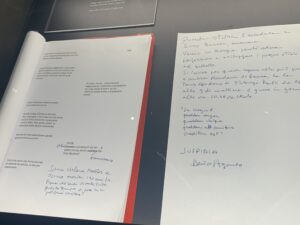
A member of the CultFilms team was fortunate enough to visit Dario Argento – The Exhibit at the National Museum of Cinema in Turin so we thought we’d share an insight into the exhibition for those who are unable to make the pilgrimage but would like to know more about this impressive testament to the work of one of Italy’s most formidable and creative directors of horror cinema.

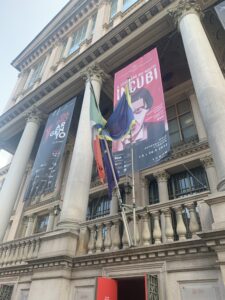
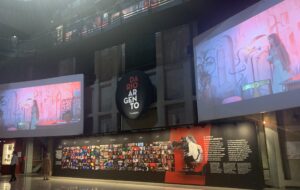
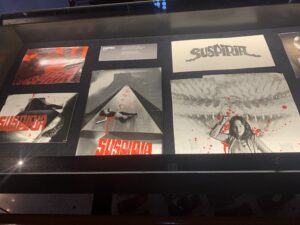
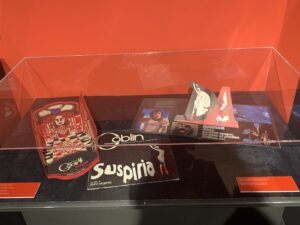
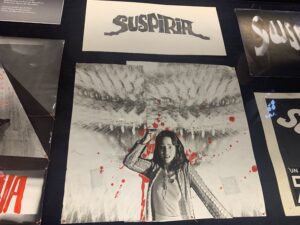
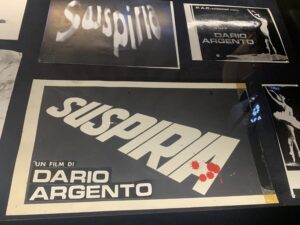
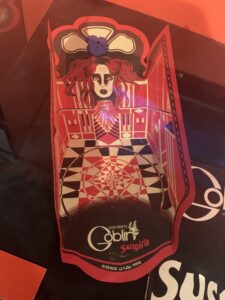
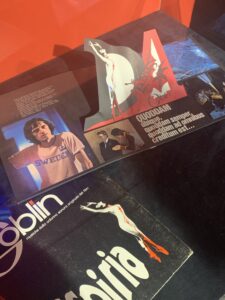
As one enters the impressive Mole Antonelliana, one is struck by the scale and focus dedicated to Dario Argento: The Exhibit. Colour and sound design are of great importance to Argento’s cinema and this is reflected throughout the sprawling exhibition space which is cast in red, green and other candy coloured hues befitting of the director who bequeathed to the world the phantasmagorical fairytale of SUSPIRIA. Carefully curated clips play on the museums dual cinema screens displaying the creative ingenuity of Argento’s work throughout his cinematic career accompanied by music from frequent collaborators Ennio Morricone and Goblin. The museum’s permanent chaise lounge style seating gives visitors the opportunity to soak in the director’s visually arresting oeuvre in comfort either before or after taking in the macabre delights of the exhibition.

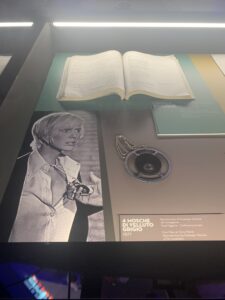
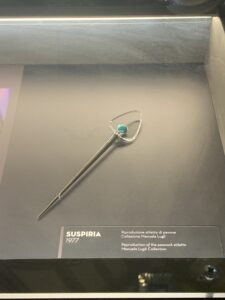
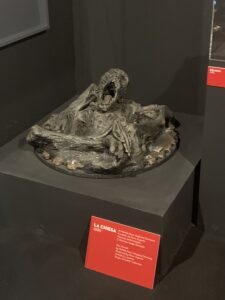
The main portion of Dario Argento: The Exhibit is laid out across winding platforms which spiral up towards the dizzying heights of the Mole Antonelliana, chronologically detailing Argento’s career from his impressive cinematic debut THE BIRD WITH THE CRYSTAL PLUMAGE all the way up to his most recent endeavour, OCCHIALI NERI. Argento’s films are represented via large boards detailing the premise of each film, choice quotes from Argento, select images and video clips and general information such as box office takings and cast. These boards are flanked with various relevant props and other paraphernalia such as scripts and concept drawings. Fans of Argento will likely revel in the selection of iconic props on display which include the sinister bucktoothed pupazzo head in DEEP RED, Peter Neal’s infamous novel TENEBRAE, a sculptural shard of the peacock statuette in SUSPIRIA and the perspex fly necklace from FOUR FLIES ON GREY VELVET. Costuming is also represented via the stunning bejewelled costumes of Betty’s Lady Macbeth in OPERA to Giorgio Armani’s tailored utilitarian creations for Jennifer Connelly in PHENOMENA and the less glamorous but equally memorable austere uniform of Alida Valli’s Miss Tanner in SUSPIRIA. Perhaps one of the more surprising props on offer is the graffiti monster from THE STENDHAL SYNDROME complete with oversized appendage! As you ascend the walkway taking in each film and its respective props, you embark on an exciting journey through Argento’s career illustrated by a diverse and colourful collection that pays tribute to an enduring and influential cinematic legacy.

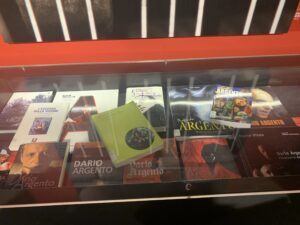
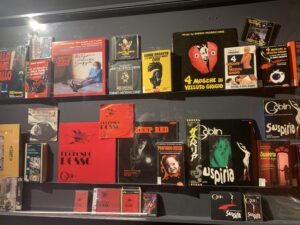
Whilst Argento’s directorial career in cinema is the exhibit’s main focus, his televisual work such as DOOR INTO DARKNESS is also recognised alongside his work as a producer on seminal horror titles such as Lamberto Bava’s DEMONS and Michele Soavi’s THE CHURCH and THE SECT. Props for the aforementioned films including Menelik the demon from DEMONS II and the goat devil hybrid creature from THE CHURCH are on prominent display and are some of the most memorable items featured throughout the exhibition. As the scores to SUSPIRIA and DEEP RED reverberate in the background, it feels fitting that the importance of music to Argento’s filmography is also recognised via its own display complete with reverberating platform where one can physically experience the music of Claudio Simonetti. A further display gives insight into the influence and cultural impact of Argento’s work through the copious number of books written about the filmmaker in a variety of languages from across the decades. The exhibition is rounded off with an engaging interview with Argento about his career featuring a number of insightful and humorous anecdotes — including a very funny Morricone FOUR FLIES ON GREY VELVET story — that relay Argento’s experiences and creative processes as a filmmaker. As one leave the main exhibition space, a mirror hangs with an oh so familiar painting for Argentophiles — an ode to one of Argento’s most lasting images which visitors can recreate for themselves in their own tribute to seminal giallo DEEP RED.

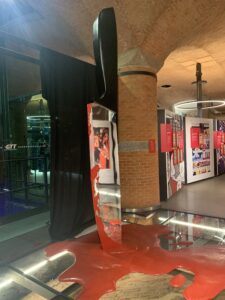
The influence and legacy of Argento’s cinema is reflected in a further display away from the main exhibition space. In this separate area, a Dario Argento themed issue of Italian magazine Linus with artworks inspired by the maestro and his films are displayed featuring a mix of mediums from comic strips to oil paintings. Before exiting to the shop, an enormous mirrored knife dripping with blood stands tall offering visitors a final chance for a photo opportunity. And for visitors not content with all the exhibit has to offer, information is provided via a handy QR code to the locations of many of his films which were filmed in the city of Turin, a city Argento always marvelled at the magical quality of and a fitting location for a tribute to his daring and illustrious career.


Dario Argento: The Exhibit runs at the National Museum of Cinema in Turin until the 16th of January 2023.

DARIO ARGENTO: THE SYMPHONY OF FEAR is available to purchase now from CultFilms.


Dario Argento Exhibit Museum Exterior
Dario Argento Exhibit Suspiria on the screen
Dario Argento Exhibit Four Flies on Grey Velvet
Dario Argento Exhibit Suspiria Miss Tanner (Alida Valli) costume
Dario Argento Exhibit Suspiria Crystal Wand
Dario Argento Exhibit Suspiria
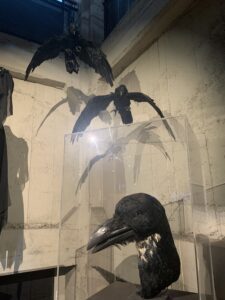
Dario Argento Exhibit Opera Crows
Dario Argento Exhibit Opera Dresses
Dario Argento Exhibit The Church
Dario Argento Exhibit Suspiria
Dario Argento Exhibit Books
Dario Argento Exhibit Films
Dario Argento Exhibit Museum
Dario Argento Exhibit Suspiria
Dario Argento Exhibit Goblin
Dario Argento Exhibit Suspiria Goblin
Dario Argento Exhibit The Church
Posted on

Saadi Yacef 20 January 1928 – 10 September 2021

We have learnt of the Passing of Senator Saadi Yacef, whose autobiographical story is the source of Gillo Pontecorvo’s masterpiece THE BATTLE OF ALGIERS. Yacef wrote his experience as leader of the Liberation Front fighting for the independence of Algeria from the French whilst on death-row. Reprieved, and soon after with Algeria a nascent sovereign state, Yacef sought Pontecorvo, he ended coproducing and – at Pontecorvo’s insistence – agreed to play ‘himself’ in THE BATTLE OF ALGIERS which won the Venice Film Festival. The beginning, the making and the rest is history…
Some of us at CultFilms had the extraordinary privilege to meet and speak with Saadi a few times over the years, it was a life-affirming honour.

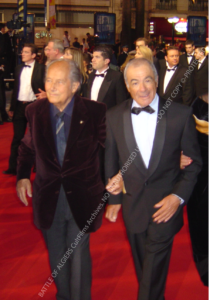
From left, Gillo Pontecorvo and Saadi Yacef for the screening of THE BATTLE OF ALGIERS at Cannes Film Classic


From left, Saadi Yacef with Director Gillo Pontecorvo on the set of THE BATTLE OF ALGIERS


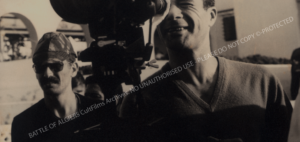
Saadi Yacef looks through the camera on the set of Director Gillo Pontecorvo’s THE BATTLE OF ALGIERS


Posted on

Letter from Liliana Cavani

We are proud to present director Liliana Cavani’s open letter in heartfelt reaction to certain articles published in the national press upon our release of her film “The Night Porter”.

Photo Liliana Cavani  1974  Mario Tursi

As usual, these gentlemen can’t manage to watch a film without having a preconceived idea about it, without comparing it to this or that other film because it’s about the same period in time. 

Do I exaggerate if I say, once again, that a woman making films is still struggling to be taken seriously?  Luckily there have been many excellent critics who have liked my cinema, but I must say that this is demoralising.   And furthermore, I find that rather tediously I keep defending myself trying to explain my intentions to these all-knowing critics, knowing very well that they won’t make the least effort to understand me or at least to manage to watch my film with an open mind.

My first reaction would be to just tell these scribblers writing about my film to “sod off”.  My film seems easy, but it isn’t, it’s difficult, it is directed to those who pay attention to what happens in it.  I certainly didn’t make to cause a “scandal” in fact, I meant to pass down what happens in Human History, what happens if power is in the hands of fools and how horrible the consequences are. 

The film centres on a woman, a victim, the protagonist who was hurt in a way that cannot be healed, she was hurt by some bastard such as the nazis were.   She was saved by one of them, maybe the less foolish, in fact someone able to feel something similar to love, this feeling that seems common and instead it’s rare because it’s love that slowly makes us human and if we are human we understand that we can’t bring light where there is too much darkness. 

We understand that there is a price to pay so that this feeling can really become love.  Lucia knows all this and her partner knows it too because love comes always with a price to pay, Lucia is ready for this and passes this on to him.  This is my film. 

The best French critics have understood this and part of US and British critics have too and who cares if the New Yorker’s Pauline Kael, who was also a little misogynist, did a hatchet job of it, it was her full right as it was the right of other American critics who wrote about the film,  more than negative they were mostly ignorant. 

 In Italy the critics have been negative, but those whom I respected understood the film and this also happened in France and in London.   It is also rather upsetting that Primo Levi, a lager survivor has been mentioned, he didn’t like the film and I understand that.  But his is an opinion and not a verdict.  I met Primo Levi in Cuneo, I wanted his opinion on two women of the Resistance one who had survived Auschwitz and the other Dachau, who couldn’t remove their experience from their mind. I’d met them whilst researching a documentary I made for Rai about “Women in the Resistance”.  Levi didn’t want to talk about his experience and I understood that.  It’s not easy to talk about it for a victim. 

When years later, I made “The Night Porter” I knew that the first seed of that film was my experience when making that documentary.  Why did I make that film?  It’s like asking “Why do you exist?  It stemmed from my work on another four hours documentary on the Third Reich.  Whilst researching that I watched hours of archive material on the opening concentration camps in Germany and Poland. 

And that’s why I’m disappointed, I thought that the journalist I spoke to had understood.  But I also wish to thank him because I’m sure that he meant to be kind.       Liliana Cavani


Posted on

The Night Porter: An Essay by Kat Ellinger

It is a pleasure to present this new original piece on THE NIGHT PORTER, written by Kat Ellinger, the editor-in-chief of Diabolique Magazine especially to inaugurate the launch of CultFilms new 4k-restored edition of Liliana Cavani’s beautiful yet confounding, controversial film.

Night Porter Cavani Kat Ellinger

The Night Porter: Sex & Death in the Realm of Fatalist Romance.

Described by The New York Times when it was first released as ‘romantic pornography’ Liliana Cavani’s The Night Porter (1974) began its run of initial theatrical screenings under a cloud of controversy. Roger Ebert’s haughty claim that… “The Night Porter is as nasty as it is lubricious, a despicable attempt to titillate us by exploiting memories of persecution and suffering”… is indicative of just how far some critics missed the point. Pauline Kael added her own vitriol to the chorus of moral arbiters when she wrote in The New Yorker, “Many of us can’t take more than a few hard-core porno movies, because the absence of any human esteem makes them depressing rather than sexy; ‘The Night Porter’ offers the same dehumanized view and is brazen enough to use the Second World War as an excuse.” Yet, while The Night Porter is provocative, deliberately so, it is neither remotely pornographic, nor exploitative. And if this is the case, one has to ask, what is it that bothered critics so much about the film?

During the seventies, thanks to the decline in censorship, romance took something of a dark turn. Traditionally, at least in a literary sense, the genre has always been populated by stories of forbidden fruit or doomed lovers — take for example Shakespeare’s opus Romeo and Juliet (1597); its power lies in the fact that everyone is dead by the time the curtain falls, and there is no happily-ever-after. Films like The Night Porter arrived like a crashing wave to put an end to Hollywood fairy tales, which had dominated the Hays Code era, restoring romance to the realm of the fatalist. Like everything that breaks the rules, rallies against the status quo, it kicked up an entire storm in its wake; with some critics, like those mentioned above, taking the film very personally indeed.

I would argue that The Night Porter, far from belonging to the wave of pornography that rose up in the seventies, holds coven with another movement from the period: the destructive romance, which in part began in the decade prior, through films like Luis Buñuel ’s Belle de Jour (1967), or Yasuzo Masumura’s Blind Beast (1969). Other powerful examples include Bernardo Bertolucci’s Last Tango in Paris (1972) — which caused its own furore when it hit American cinemas, and still continues to court controversy — Andrzej Żuławski’s L’important C’est D’aimer (1976), Walerian Borowczyk’s La Marge (1976), Paul Mazursky’s Blume in Love (1973) or Nagisa Ōshima’s In the Realm of the Senses (1976). Each of these films turned to look at the destructive obsessive qualities inherent in romance, vomiting in the face of ideology governed by themes of redemption and goodness, to instead focus on love as a profoundly complex form of spiritual decay.

Cavani’s The Night Porter is a deeply misunderstood film, frequently placed in the canon of Nazisploitation; a cycle of exploitation film that came largely off the back of Lee Frost’s Love Camp 7 (1969), the commercial success of which propelled (mainly) Italian producers to embark on an entire spree of like minded pictures: for example, Gestapo’s Last Orgy (1977), Ilsa, She Wolf of the SS (1975), The Beast in Heat (1977). In addition, the Italian arthouse crowd had started to examine the theme of fascism within the backdrop of WWII; Luchino Visconti’s The Damned (1969), Bertolucci’s The Conformist (1970), Pier Paolo Pasolini’s infamous Salò, or the 120 Days of Sodom (1975). Even the American musical, via Bob Fosse’s adaptation of Christopher Isherwood’s Berlin Stories, Cabaret (1972), was starting to sail into the same murky waters. While Tinto Brass’ Salon Kitty (1976) sat in the middle ground between political metaphor and outright eroticism.

As a result, writers like Susan Sontag worried about the eroticisation of the holocaust in her essay Fascinating Facism for New York Review of Books (February 6, 1975) stating, “If the message of fascism has been neutralized by an aesthetic view of life, its trappings have been sexualized. This eroticization of fascism can be remarked in such enthralling and devout manifestations as Mishima’s Confessions of a Mask and Sun and Steel, and in films like Kenneth Anger’s Scorpio Rising and, more recently and far less interestingly, in Visconti’s The Damned and Cavani’s The Night Porter.” Filmmakers were suddenly touching the untouchable, and it made certain people incredibly uncomfortable.

Unlike Naziploitation, The Night Porter does nothing to cartoonise the Nazi officers that dominate the narrative. It isn’t a case of good versus evil, or that sadism is presented as a form of lasivious softcore pornography. Neither is the film a deliberate political treatise like the art films of Bertolucci, Visconti, or Pasolini. Its biggest transgression is that it humanises one of its main characters, Max (Dirk Bogarde), a former Nazi officer with a penchant for sadism, when he finds his ‘little girl’ again in the postwar period; a former concentration camp inmate Lucia (Charlotte Rampling) with whom he undertook a sadistic affair while she was incarcerated. On reuniting it is clear that their loved never died, so they continue, even though they know it will eventually contribute to their downfall and consequent death. Love in this realm is desperately profane, disgusting, something that should never be. And because of this it remains infinitely fascinating and uniquely humanistic.

In her exclusive interview for this new restoration by Cult Films, director Cavani states she got the initial idea for the film after making two documentaries on the holocaust early on in her career for Italian television. She reveals that watching archive footage of concentration camps and speaking to two camp survivors was a traumatic experience for her, one that continued to resonate for years afterwards. But it was because of one of those interviews—  with a woman who was compelled to revisit her former camp year after year —  that the director realised for many the war might have been over, but the trauma remained; especially because many of those survivors were unable to speak openly about their experiences. To some it felt like a dirty secret they were all condemned to share.

The Night Porter takes the ultimate dirty secret and lays it bare for the world to see. The theme of collaboration has always been a bitter pill to swallow when it comes to stories about WWII. For instance, Juraj Herz’s The Cremator (1968) was banned by the Communist regime in its native Czechoslovakia for delving into such themes. While, Zbyněk Brynych’s The Fifth Horseman is Fear (1965) — produced by Italian Carlo Ponti but also made in Czechoslovakia—  took a similar route into Gothic horror, exposing informers in the period of Nazi occupation; as did the director’s previous picture set in a Jewish Ghetto Transport from Paradise (1962). Henri-Georges Clouzot’s Le Corbeau (1943) can be read as an allegory on the themes of fear, suspicion, paranoia, and informing, that took place in France during the war. While Roger Vadim’s Vice and Virtue (1963) used the backdrop of WWII to re-imagine De Sade’s Justine and Juliette, with the “evil” sister Juliette (played by Annie Girardot) depicted as a woman desperate to survive the occupation, having sold her soul through sexual favours to Nazi officers.

When it comes to the themes of collaboration in Cavani’s film, much like Vadim’s aforementioned Vice and Virtue, it uses the concept of sex as a starting point for further exploration. When we first meet Lucia in the camp she is a very young girl taken under the wing of Max, as they begin to play out their power games. At first it is he who holds all of the cards. Yet, there is an obvious shift in one of the only outwardly erotic scenes in the film, when Charlotte Rampling gives a bare breasted rendition of Marlene Dietrich’s Wenn ich mir was wünschen dürfte (If I Could Make a Wish) to a crowd of officers, whilst partially dressed in Nazi uniform (in a deliberately peverse touch, which in and of itself is highly symbolic as if she is reclaiming that power and mocking her oppressors all at the same time).

Even though the scene is admittedly titillating —  largely because of Rampling’s beguiling performance —  it speaks heavily to the power of a woman’s sexuality, even under the most extreme circumstances. It is Lucia who has the power as she manipulates her body, while the men can only look on in awe. And it is at this moment that we realise Max is just as much under her spell, as she is his. Although, while she has no choice but to play the game, he could easily walk away. The fact that he can’t tells us everything we need to know.

Nor can either of them walk away when they meet again in the postwar period. Both are compelled to act out the extreme behaviours of their past, even though it puts them at risk of total destruction. Their shared experience is a secret they both share, and it is a secret they both appear to covet, no matter how perverse or rotten it is. As Rampling reveals in her new interview for this Cult Films release, both her and co-star Dirk Borgarde made the film under the utter conviction that it should be a love story, first and foremost — when Cavani had initially conceived the film to be somewhat more intellectual.

Actors Bogarde and Rampling’s respective performances pack the narrative with emotional intensity; running the gamut from wide-eyed giddy love, to the other end of the spectrum: disgust and shame. What seems to challenge viewers so much is Lucia’s complicity in this. In taking this view it ignores the fact this is a woman who was severely abused during her formative years, learning, tragically, this might be the only way she can love. Yet, the fact that she goes to Max willingly, and in one of the only graphic sex scenes — in which no nudity is shown — it is she who mounts him, driving the penetration, is taken by many as the ultimate betrayal. As Rampling states in her aforementioned interview a large number of critics were of the view “how dare she!”

In his book Dirk Bogarde: Matinee Idol, Art House Star, Dr. David Huckvale argues that The Night Porter is a Gothic film, pointing to Bogarde’s position as a traditional anti-hero/villain (the Byronic mold) as well as his ambiguous sexuality to make his point. I would agree wholeheartedly with this statement. As a fan of Gothic it’s one of the things I love about the film so much. When it comes to the themes of sex and love within the canon of Gothic, sadism, abuse, sickness, almost always follows. This is the most powerful aspect of Cavani’s film. Had it been an outright horror film, it might have been easier for viewers to swallow. It is, much like Bram Stoker’s Dracula, at its core a fatalistic love story, in which a woman falls in love with a monster. As such, the film arguably has much more in common with Clive Barker’s Hellraiser (1987) — and its damned love affair between Frank and Julia — than it does many of the Nazi-based films that were made during the seventies. Max, like Count Dracula, is forced to lurk in the shadows, admitting that he works at night because he feels a sense of shame when he’s in the light. It is this shame that governs the love he shares with Lucia. However, what sticks in the throats of critics who have condemned the film, isn’t Max’s monstrosity, it’s his vulnerability, his complexity, his love, his humanity.

Posted on

DARIO ARGENTO MEETS MICHELANGELO ANTONIONI

Maestro meets Maestro and his masterpiece!

Dario Argento – whose self-appointed remit is to shatter our interior emotions – salutes Michelangelo Antonioni, whose psychoanalysis of our internal emotions is seen as the creation of Modern Cinema language..!


Dario Argento bows to Michelangelo Antonioni

The Maestro of Horror – whose self-remit is to shatter our interior emotions – appears deeply moved as he salutes Michelangelo Antonioni, who is revered as the creator of Modern Cinema with his sober psychoanalysis of our internal emotions…


Posted on

STORY OF A LOVE AFFAIR – MICHELANGELO ANTONIONI

Story of a Love Affair AntonioniWe are excited to announce our next release on Bluray: Michelangelo Antonioni ‘s first feature film –Story of a Love Affair – a noir-tinged masterpiece.
To celebrate this release, we’re offering the chance of watching it online at the discounted price of £2.75 by following this link https://bit.ly/2WiAERW (offer ends the 8th of July at midnight).

Released for the first time ever in Blu-Ray this was one of the first classics to be chosen for restoration in HD. The restoration was supervised by Giuseppe Rotunno, Fellini’s cinematographer

Beautifully shot and very stylish, Story of a Love Affair displays all the traits typical of Antonioni’s films and it marks the end of Neorealism as it concentrates on a more intimate cinematic vision.

The storyline of this film tackles modern issues of incommunicability, alienation and existential unease but at the same time, it’s a classic film noir with a solid plot which tells the story of an adultery and of a possible murder, set in the glamorous world of the upper class in Milan.

The film starts with some pictures of a beautiful young woman, Paola, played by the stunning Lucia Bose’.  Having found these photographs of his wife, the husband becomes jealous and decides to find out what kind of woman he married. What life did she have before? Intrigued by these photos of his wife and eager to discover her past, her husband has her followed by an investigator who accidentally gets her back together with a former lover. 

“Story of a Love Affair” has been defined by critics as one the most accomplished directorial debut. It is visually stunning thanks to beautifully composed shots which come alive with sophisticated and accomplished camera movements: incredible long shots, tracks and pans follow the actors as they move in a landscape which is familiar and alien at the same time.
Antonioni was brilliant at depicting moods and conveying emotions through camera movements: in this film, there are about 20 long shots which are over one minute long to reflect the restless feeling of the relationships between the characters and which reveal his incredible fluency and mastery of camera technique.  Below you can find one of longest shots, over 4 minutes, of a dramatic conversation taking place on a bridge.

The long take of the conversation the two lovers have on the stairs of a building where they meet secretly is one of the most imitated long takes in cinematic history.   

Fashion is always important in Antonioni’s films and he uses architecture, art and costumes to establish moods and states of mind as well as for their intrinsic visual value. In “Story of a Love Affair” costumes are more important than ever both to describe his characters visually as well as to depict their unresolved issues.   Italian fashion was born in 1950 and Antonioni convinced one of the most iconic ’50s fashion designers, Ferdinando Sarmi, to create the fabulous costumes worn by Lucia Bose’, and to play her husband. Sarmi gave a great performance though he had never acted before nor did he after this experience. His designs are amazing and Lucia Bose’ looks stunning in some of the most spectacular ball gowns and the most elegant suits.

“Story of a Love Affair” completely breaks from Neorealism and marks the beginning of modern auteur cinema.  Antonioni employs a very personal style which is instantly recognisable and aims to describe the difficulty of living and understanding reality around us in an open manner rather than follow a precise sequence of events in order to create a sense of angst.
The camera, the surroundings and the props tell the story more than the narrative does by creating an impression which is perceived rather than outlined by the story or by the dialogue. In his films Antonioni is constantly asking questions and he presents his characters impartially: they are not without blemishes but he shows them without judging them.  Ultimately it’s left to us, the viewers, to provide the answers. 


Posted on

VITTORIO GASSMAN TRIBUTE

Vittorio Gassman Documentary

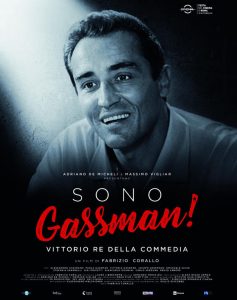
This week, we are delighted to present the UK online Premiere Screening of “Let me speak: I am Vittorio! Gassman King of Comedy” an award-winning, insightful documentary on the films, life and career of the actor Vittorio Gassman, one of the most cherished Italian national treasures.

Awarded the Nastro D’Argento for Best Documentary in 2019,  it’s a portrait of Vittorio Gassman, showing his vital and multifaceted interpretative abilities, through clips taken from some of the best known films from Italian cinema.

With contributions from actors and directors such as Stefania Sandrelli, Giancarlo Giannini, Jean Louis Trintignant, Ettore Scola, Dino Risi and Monicelli and also by his children, this documentary reveals a more private side, an unexpected shyness and insecurity under his apparent bravado. There are also many interviews from some of the leading protagonists of Italian comedy such as Carlo Verdone, Paolo Virzì, Paola Cortellesi and many others sharing their memories of Gassman and building up an in-depth portrait of the actor, his films and a whole period of Italian life.

This tender recollection of memories from his family and friends, is also a celebration of the golden age of Italian cinema, specifically, of the genre known as Comedy Italian Style (Commedia all’italiana), which dealt with the serious problems and challenges of life, all the while portraying them with a light touch and bitter irony, producing films that were both funny and thought provoking. 

With its rare interviews and backstage contribution, this documentary is both compelling and funny as you’ll be sure to make you laugh out loud thanks to clips from his most iconic and funny movies such as “La Grande Guerra”, “Il Sorpasso”, “I Mostri” and “L’Armata Brancaleone” which, together with recordings of stage performances and TV shows create this portrait of a great entertainer and a man with a very vulnerable side. An unmissable trip down cinematic memory lane, available only on VOD, you can watch it by clicking this link https://cultfilms.co.uk/product-category/type/view-online/